Moses asked God a question about Moses. God answered with Himself.
LL-EX3-4-OPEN-01
Are we still interruptible?
World of the listener: the ordinary morning routine.
Every morning I take about fifteen things. Prescriptions, supplements, the whole lineup.
I have done it so many times that some mornings I stand there and honestly cannot tell you whether I already did it. Same counter. Same glass of water. Same order. It has worn a groove so deep that it does not register anymore.
Moses had a chore like that. About forty years after he fled Egypt, he is eighty years old, walking his father-in-law's sheep out past the edge of the wilderness. Same sheep. Same rocks. Same long quiet.
And one morning the chore did not behave the way the chore behaves. Something burned and did not burn up.
Verse 3. He turned aside to look.
So the question this morning is not whether God is speaking. The question is whether we are still interruptible.
THE BIBLE MEETS LIFE
The Bible Meets Life
Somebody find The Bible Meets Life in your book and let’s read it together, same as always.
This is the one part of the morning I want us all in the book together.
When they finish: LifeWay’s In Focus for this session is God loves us enough to speak to us.
Their opening picture is gravity. We adjust to gravity because it is reality. Their point is that when God speaks, His voice calls for a response. We do not merely collect information; we adjust our lives to what He says.
LL-EX3-4-READ-01
Exodus 3:1–6
Exodus 3:1–6 · ESV
1 Now Moses was keeping the flock of his father-in-law, Jethro, the priest of Midian, and he led his flock to the west side of the wilderness and came to Horeb, the mountain of God. 2 And the angel of the LORD appeared to him in a flame of fire out of the midst of a bush. He looked, and behold, the bush was burning, yet it was not consumed. 3 And Moses said, “I will turn aside to see this great sight, why the bush is not burned.” 4 When the LORD saw that he turned aside to see, God called to him out of the bush, “Moses, Moses!” And he said, “Here I am.” 5 Then he said, “Do not come near; take your sandals off your feet, for the place on which you are standing is holy ground.” 6 And he said, “I am the God of your father, the God of Abraham, the God of Isaac, and the God of Jacob.” And Moses hid his face, for he was afraid to look at God.
Scripture quotations are from the ESV Bible, copyright 2001 by Crossway, a publishing ministry of Good News Publishers. Used by permission. All rights reserved.
Reader 1 • Read from your ESV Bible.
Listen for what Moses does—and when God calls.
LL-EX3-4-TEACH-01
God interrupts a chore
Look at who this man is when God shows up.
Acts 7 gives us the shape of his life. Roughly forty years in Egypt, then he kills a man and runs, then roughly forty more years out here. He is eighty. Whatever he once thought he was for, he has had four decades to stop thinking it.
📖 Acts 7:23, 29–30 · Open referenced verses
Acts 7:23, 29–30 · ESV
23 “When he was forty years old, it came into his heart to visit his brothers, the children of Israel.” 29 “At this retort Moses fled and became an exile in the land of Midian, where he became the father of two sons.” 30 “Now when forty years had passed, an angel appeared to him in the wilderness of Mount Sinai, in a flame of fire in a bush.”
Scripture quotations are from the ESV Bible, copyright 2001 by Crossway, a publishing ministry of Good News Publishers. Used by permission. All rights reserved.
And he is a shepherd. In Genesis 46 we are told plainly that shepherds were detestable to the Egyptians. That is TEXT, it is right there. So the man raised in Pharaoh's house has landed in the one job his adoptive country looked down on. What he felt about that, the Bible does not say. That part is INFERENCE and I will not push it.
📖 Genesis 46:34 · Open referenced verses
Genesis 46:34 · ESV
34 “you shall say, ‘Your servants have been keepers of livestock from our youth even until now, both we and our fathers,’ in order that you may dwell in the land of Goshen, for every shepherd is an abomination to the Egyptians.”
Scripture quotations are from the ESV Bible, copyright 2001 by Crossway, a publishing ministry of Good News Publishers. Used by permission. All rights reserved.
Now watch the order of what happens, because it is easy to read past.
Verse 2, the bush is burning. Verse 3, Moses says he will turn aside and look. Verse 4, when the LORD saw that he turned aside to look, God called to him. The turning comes first, and then the voice. That is TEXT.
Now let me put a fence around that before somebody takes it home wrong. That is not a formula. Moses did not earn a revelation by paying attention. Nobody buys God's voice with attentiveness. What the verse shows us is that Moses was interruptible. He was willing to stop the chore and go look. That is a very different thing from a transaction, and I want you to hear the difference.
Then God calls him by name. Twice. Moses, Moses. Out of a burning bush in an empty country, the first thing God says is this man's name.
And Moses hid his face, because he was afraid to look at God.
LL-EX3-4-MON-01
Monday morning
So what does that change on Monday morning?
God interrupted a man in the middle of a chore he could do without thinking about it. You are going to do that chore tomorrow. Whatever yours is. The question is not whether God is speaking. It is whether you are still interruptible.
LL-EX3-4-READ-02
Exodus 3:11–15
Exodus 3:11–15 · ESV
11 But Moses said to God, “Who am I that I should go to Pharaoh and bring the children of Israel out of Egypt?” 12 He said, “But I will be with you, and this shall be the sign for you, that I have sent you: when you have brought the people out of Egypt, you shall serve God on this mountain.” 13 Then Moses said to God, “If I come to the people of Israel and say to them, ‘The God of your fathers has sent me to you,’ and they ask me, ‘What is his name?’ what shall I say to them?” 14 God said to Moses, “I AM WHO I AM.” And he said, “Say this to the people of Israel: ‘I AM has sent me to you.’” 15 God also said to Moses, “Say this to the people of Israel: ‘The LORD, the God of your fathers, the God of Abraham, the God of Isaac, and the God of Jacob, has sent me to you.’ This is my name forever, and thus I am to be remembered throughout all generations.”
Scripture quotations are from the ESV Bible, copyright 2001 by Crossway, a publishing ministry of Good News Publishers. Used by permission. All rights reserved.
Reader 2 • Read from your ESV Bible.
Listen to Moses’s questions and God’s answers.
LL-EX3-4-TEACH-02
The name on the page
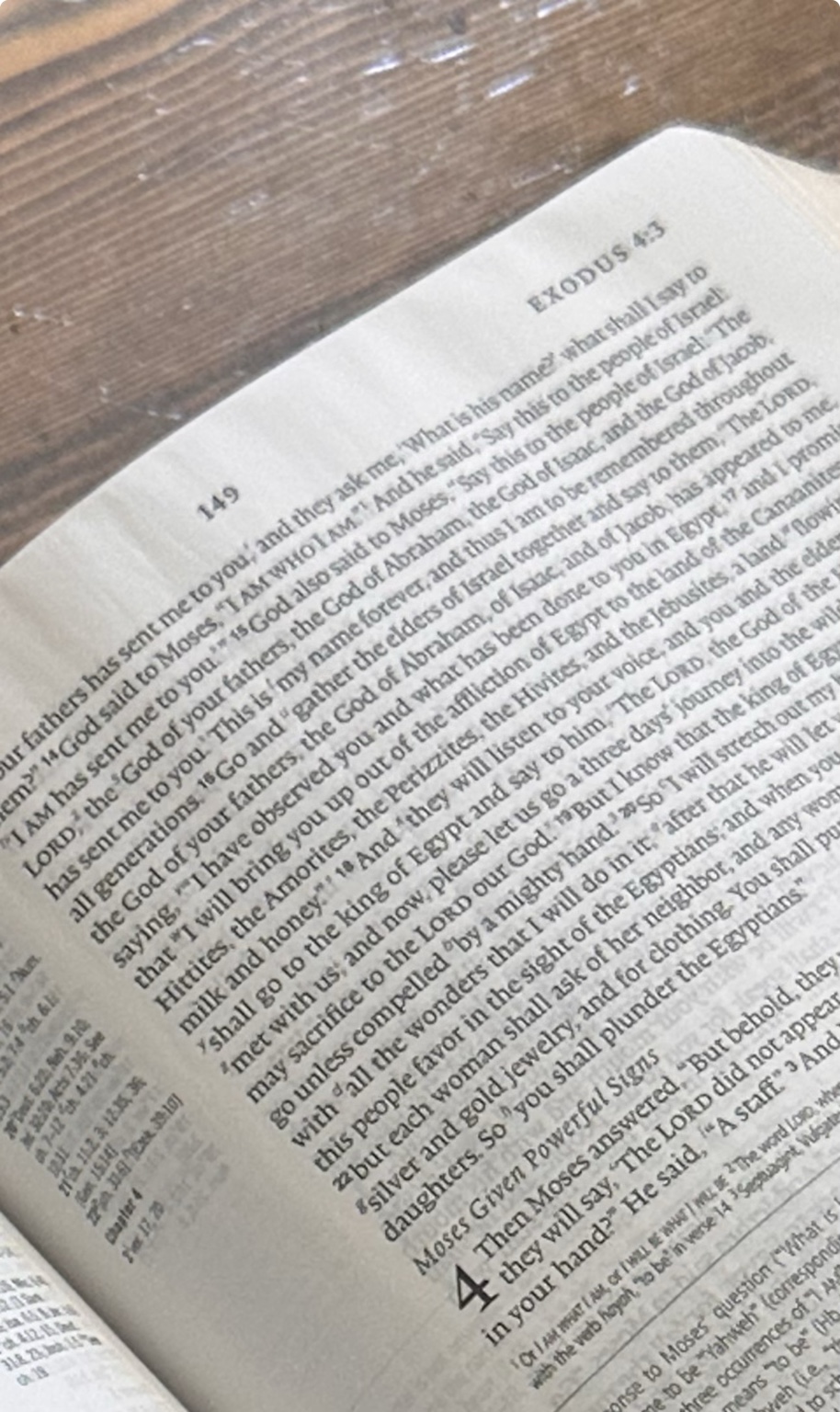
Real printed-page evidence for LORD in Exodus 3:15.
Moses asks God two questions in those verses. I want you to notice that God answers one of them and refuses the other.
First question, verse 11. Who am I that I should go to Pharaoh. That is the adequacy question. Am I enough.
And God does not say yes. Look at it. God does not build him up, does not remind him he was raised in a palace, does not tell him he has leadership potential. God changes the subject entirely and says, I will be with you.
Now I want to be careful here, because God is not brushing him off. Across chapters three and four God engages Moses at length and answers a great deal. What God will not do is answer the adequacy question on Moses's terms. Moses asks whether he is enough. God's answer is not better self-esteem. God's answer is His own presence.
Second question, verse 13. What is your name.
And that one God answers fully. I AM WHO I AM.
Here is the thing your English Bible cannot show you, and this is the one time all quarter I will bring up a Hebrew word, because English genuinely fails right here.
Underneath I will be with you in verse 12, and underneath I AM in verse 14, is the same Hebrew form.
So the shape of the conversation is this. Moses asks who am I, and God answers, I will be with you. Moses asks who are You, and God answers with that same Hebrew form, I AM WHO I AM. Then in verse 15 He gives Moses the name your English Bible represents as LORD.
Moses's adequacy was never going to carry the mission. God's presence was. The promise and God's self-identification are tied together before verse 15 gives the covenant name.
Now open your own Bible to verse 15, because I want you to see something that has been sitting in front of you your whole life.
Look at LORD in verse 15. Elsewhere you will also see Lord printed the ordinary way.
That is not my theory. It is the stated convention of the ESV, printed in the front of your Bible, and many major English translations do the same thing. You can check it before you leave.
An old Jewish reading tradition substituted Lord aloud. Many English translations reflect that by rendering the name as LORD in small capitals.
And before anybody asks: the exact ancient pronunciation is uncertain, and that is not where we are going today.
Here is what I want you to take with you. Verse 15 says this name is His forever, the way He is to be remembered in every generation. Which means every single time you have seen those small capital letters, thousands of times, since you were a child, you have been looking at the answer God gave at the bush.
LL-EX3-4-POLL-01
Which question are you asking?
ANONYMOUS LIVE ROOM POLLchecking...
Which question are you actually asking God right now?
A Who am I?
B Who are You?
C Are You with me?
D I am not asking Him anything right now
Fallback: if the network is unavailable, use a show of hands or take 2–3 responses and keep moving.
0 responses
LL-EX3-4-MON-02
Monday morning
So what does that change on Monday morning?
Most of us have been asking a question about ourselves. Am I enough. Am I too far behind. Ask one about Him instead this week, and then see whether the first question still needs the answer you thought it did.
LL-EX3-4-READ-03
Exodus 4:28–31
Exodus 4:28–31 · ESV
28 And Moses told Aaron all the words of the LORD with which he had sent him to speak, and all the signs that he had commanded him to do. 29 Then Moses and Aaron went and gathered together all the elders of the people of Israel. 30 Aaron spoke all the words that the LORD had spoken to Moses and did the signs in the sight of the people. 31 And the people believed; and when they heard that the LORD had visited the people of Israel and that he had seen their affliction, they bowed their heads and worshiped.
Scripture quotations are from the ESV Bible, copyright 2001 by Crossway, a publishing ministry of Good News Publishers. Used by permission. All rights reserved.
Reader 3 • Read from your ESV Bible.
Notice where the message finally lands.
LL-EX3-4-TEACH-03
It ends in worship
World of the listener: the passage ends in worship.
One honest note before we get to what happens here. Moses did not walk out of that conversation obedient. He argued for another whole chapter. What if they will not believe me. Then he says he is “slow of speech and of tongue.” Scripture does not tell us that he stuttered; it tells us that Moses saw his speaking as another reason he was the wrong man. And finally, essentially, please send somebody else. Chapter 4 verse 14 says the anger of the LORD was kindled against him.
📖 Exodus 4:10–14 · Open referenced verses
Exodus 4:10–14 · ESV
10 But Moses said to the LORD, “Oh, my Lord, I am not eloquent, either in the past or since you have spoken to your servant, but I am slow of speech and of tongue.” 11 Then the LORD said to him, “Who has made man’s mouth? Who makes him mute, or deaf, or seeing, or blind? Is it not I, the LORD? 12 Now therefore go, and I will be with your mouth and teach you what you shall speak.” 13 But he said, “Oh, my Lord, please send someone else.” 14 Then the anger of the LORD was kindled against Moses and he said, “Is there not Aaron, your brother, the Levite? I know that he can speak well. Behold, he is coming out to meet you, and when he sees you, he will be glad in his heart.”
Scripture quotations are from the ESV Bible, copyright 2001 by Crossway, a publishing ministry of Good News Publishers. Used by permission. All rights reserved.
So the bush got his attention, and the name told him whose errand it was, but the obedience took a while. I find that encouraging and I suspect you do too.
Now watch where God's speech finally lands, because it does not stop where we would stop it.
Moses tells Aaron. Aaron tells the elders. The signs are done in front of the people. And then verse 31. The people believed. And when they heard that the LORD had seen their affliction, they bowed their heads and worshiped.
Look at that chain. God speaks. Moses hears. The message gets carried. The people believe. The people bow.
So God is not speaking so that Moses can collect accurate information about God. Passing it along is a step, not the finish line. The passage ends in worship.
And here is where it goes for us.
At that bush, Moses hid his face, because he was afraid to look at God.
Centuries later a man stood in the temple courts and said, before Abraham was, I am. They picked up stones, because they understood Him to be making an enormous claim about Himself.
📖 John 8:58–59 · Open referenced verses
John 8:58–59 · ESV
58 Jesus said to them, “Truly, truly, I say to you, before Abraham was, I am.” 59 So they picked up stones to throw at him, but Jesus hid himself and went out of the temple.
Scripture quotations are from the ESV Bible, copyright 2001 by Crossway, a publishing ministry of Good News Publishers. Used by permission. All rights reserved.
Matthew closes his Gospel with that same man giving His disciples a promise. I am with you always.
📖 Matthew 28:20 · Open referenced verses
Matthew 28:20 · ESV
20 “teaching them to observe all that I have commanded you. And behold, I am with you always, to the end of the age.”
Scripture quotations are from the ESV Bible, copyright 2001 by Crossway, a publishing ministry of Good News Publishers. Used by permission. All rights reserved.
Now let me tell you plainly what kind of claim I just made, because I do not want to slip anything past you. Exodus does not say that. Exodus does not tell you the voice in the bush is Jesus. That is a Christian conclusion about how the whole Bible fits together, and I am naming it as a conclusion rather than pretending the text says it.
And across all those centuries the promise did not change. It just got a face.
LL-EX3-4-MON-03
Monday morning
So what does that change on Monday morning?
They heard, and then they bowed. Information was not the finish line for them and it is not for us. Tell one person, and then go worship.
LL-EX3-4-QUIET-01
I will be with you.
Exodus 3:12 · ESV
12 He said, “But I will be with you, and this shall be the sign for you, that I have sent you: when you have brought the people out of Egypt, you shall serve God on this mountain.”
Scripture quotations are from the ESV Bible, copyright 2001 by Crossway, a publishing ministry of Good News Publishers. Used by permission. All rights reserved.
Phones down. Sixty seconds, and I am going to be quiet.
[Read Exodus 3:12 once, slowly. ESV.]
[Say nothing. Do not fill it. Do not explain it. Let the sixty seconds run.]
LL-EX3-4-OBEY-01
Moses had Aaron. Who is yours?
Monday application: tell one person one true thing.
One thing this week. Not three.
Before Wednesday, tell one person one true thing God has said to you. Not a testimony. Not a speech. One sentence.
Moses had Aaron. Who is yours?
LL-EX3-4-PRAY-01
Let us pray
Father, thank You that You love us enough to speak. When we ask whether we are enough, turn our eyes away from ourselves and back to You. Make us interruptible this week. Help us hear Your Word, trust what You say, and carry one true thing You have said to someone else. Do not let us stop at information. Bring us to belief, obedience, and worship. And thank You that Your promise still stands: You are with us. In Jesus’ name, amen.
LL-EX3-4-CLOSE-01
Learn. Love. Live.
Learn. Love. Live. See you next week.
AFTER ACTION REVIEW
Before you leave the room.
Two minutes now is worth more than twenty minutes tonight. This saves to this device and also appears on the lesson’s After Class Capture page.